

By Marijn Versteeg
Why AI search is changing your marketing, and why you don't need an expensive agency for it
It happened to a client of mine this month: three different agencies pitched a so-called "GEO programme". After a glance at the proposals, the truth quickly came out: two of the three parties were simply selling traditional SEO, but with a trendy new label. The same keyword analysis, the same link building, just a different cover page.
This is typical of the current state of GEO: a real, meaningful change is taking place, but right now there is also an enormous amount of shouting around it. In this blog I explain soberly what GEO really is, why it matters and what you, as an in-house marketing team, can do yourself this month. Without that quote for a few thousand euros.
What are GEO and AEO, really?
GEO stands for Generative Engine Optimization. It comes down to setting up your content and online presence so that AI systems mention your brand when a user asks a question. Think of chatbots such as ChatGPT, Google Gemini, Copilot, Claude and the AI overviews that increasingly appear at the top of Google's search results.
In the corridors you'll also often hear the term AEO (Answer Engine Optimization). In practice these two terms are used interchangeably, and the difference is therefore not interesting for most marketing teams.
What does matter is the fundamental shift in search behaviour: in the past, someone searched on Google, got ten blue links and clicked through to a website. Now someone asks a question and immediately gets a ready-made answer. The crucial question for your marketing is: is your brand woven into that answer?
Why it matters now
This is not distant future music. According to forecasts from eMarketer, by 2026 almost a third of people will use generative AI to look things up, alongside or instead of a classic search engine.
This changes the foundation of marketing: part of your audience will soon land on an answer without ever having visited your website. Not mentioned by the AI? Then you simply don't exist in that conversation. And unlike with traditional SEO, you won't see this directly as a drop in your organic traffic, because that traffic was never there in the first place.
Fortunately, you don't have to wait passively. Researchers from Princeton and Georgia Tech, among others, have shown that with the right approach you can significantly increase the chance of AI systems citing your content. So you can influence it directly.
The hype problem: what actually works?
Because the term GEO is only a few months old and the definitions are not yet fixed, there is a long line of agencies ready with impressive dashboards and expensive programmes. Much of what is sold as "new", however, is not. It is work you probably should have been doing for a long time.
If we filter out the noise, a surprisingly sober list remains. AI systems prefer content that:
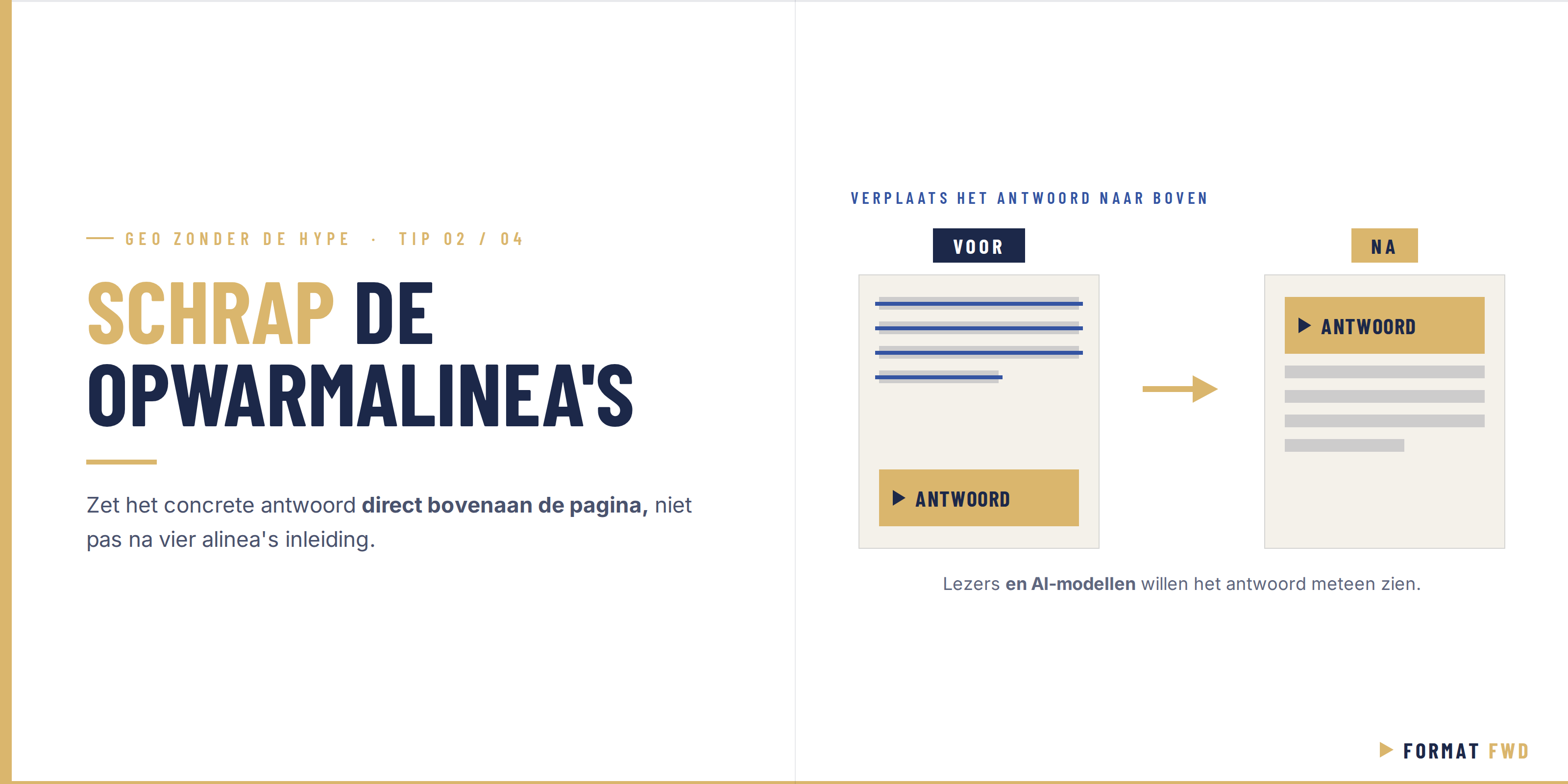
- Answers a real question directly. Not after four paragraphs of textual warming up, but right away. The answer is at the top, the detailed explanation follows below.
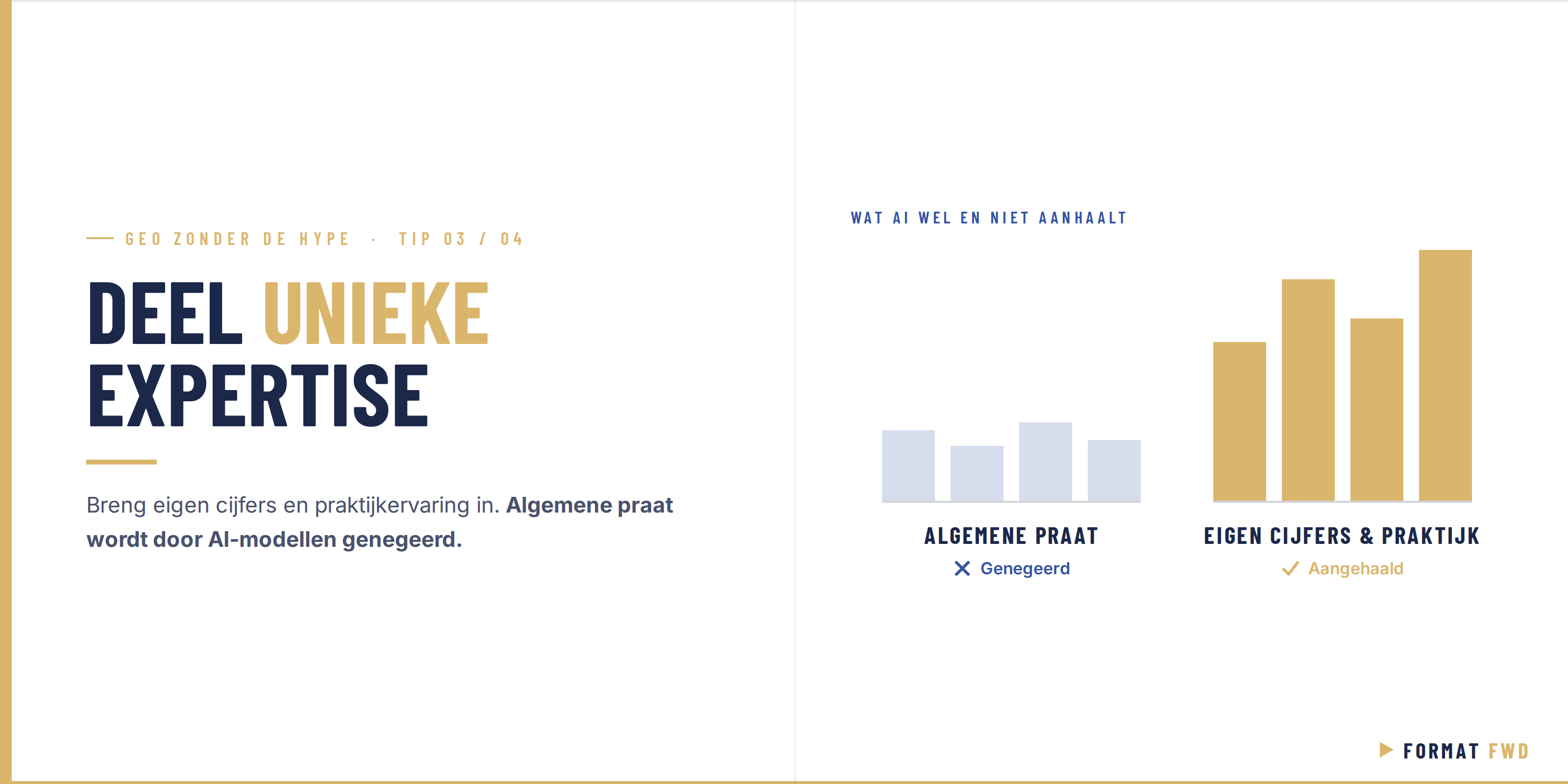
- Has substance. AI models filter out generic talk that can be found everywhere. They look for unique, proprietary figures, hands-on experience and a clear point of view.
- Has a recognisable source. The AI weighs up whether others take you seriously. This means content written by an expert with a name and a face, and a brand that is also mentioned positively elsewhere online.
- Appears consistently. One good page is not a strategy. Regularity and a reliable stream of content are.
So GEO is not a complicated technical niche. It is simply good content, clearly written by someone who knows what they're talking about. The AI is at most a new reader with a number of specific preferences.
What you can do yourself this month
You don't need an external agency to start. Your in-house team can get going today with these four steps:
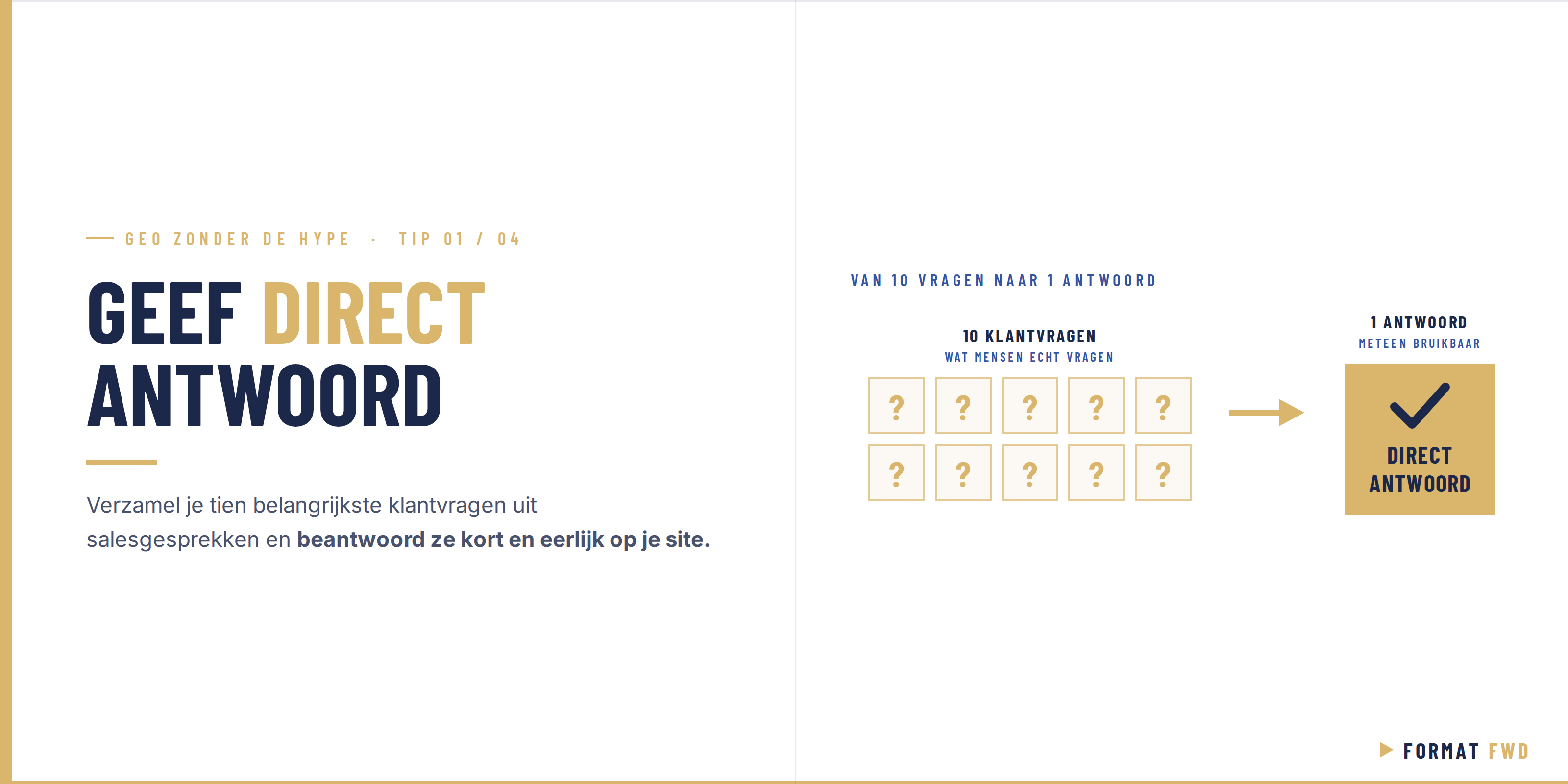
1. Collect the ten most important customer questions, for example from sales conversations, and give a direct, honest answer to each of them on your site.
2. Cut the warm-up paragraphs and put the concrete answer right at the top of every crucial page.
3. Ask ChatGPT, Copilot and Claude what they say about your product category and your main competitors. Look critically at whether and how you appear in it.
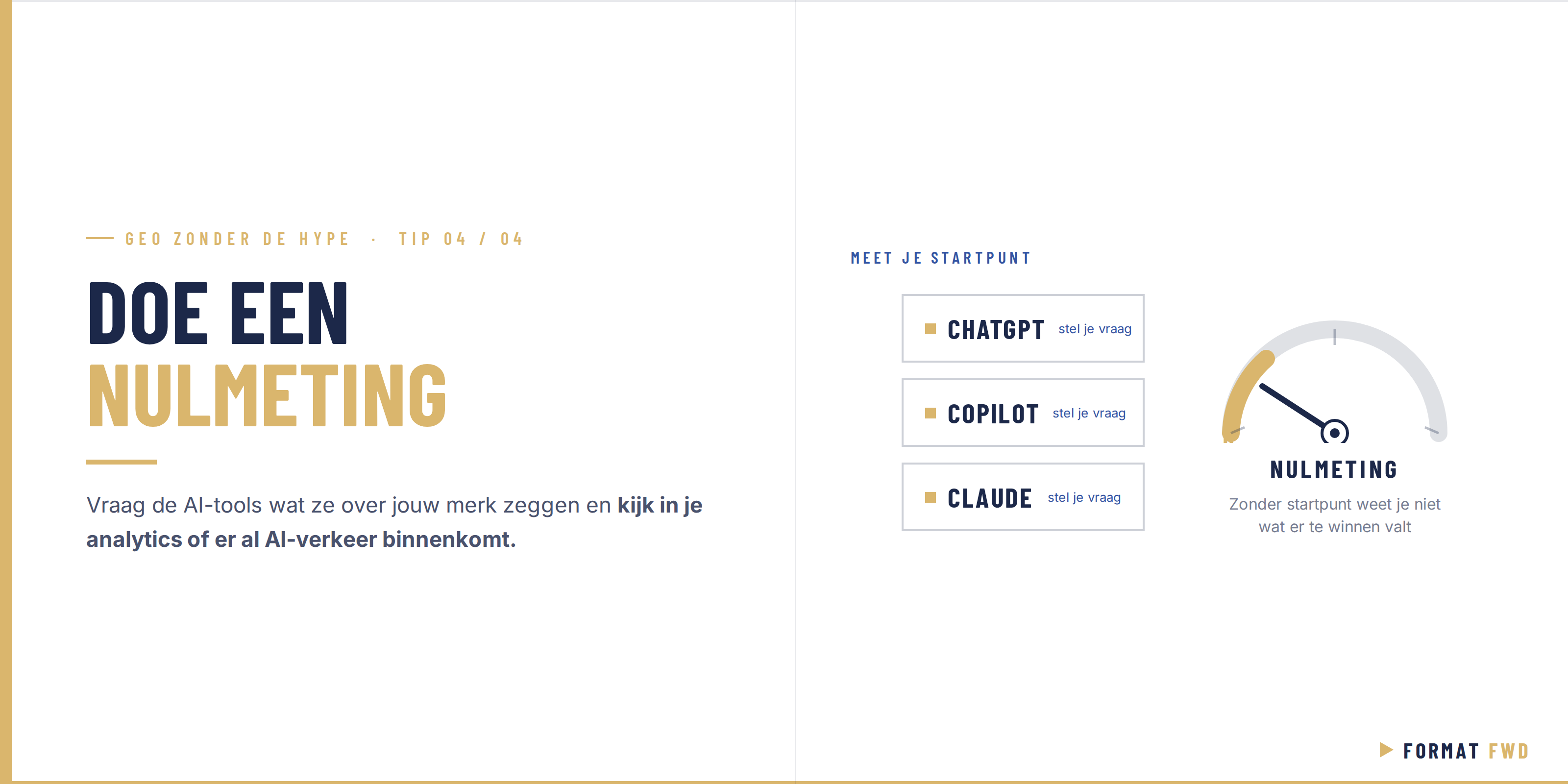
4. Check in your analytics whether visitors are already coming in via AI tools. This forms your baseline measurement.
When can you let it go for now?
Let's be honest: not every company needs to be on top of this today. Are you in a market where people aren't searching for solutions via AI at all yet, or haven't you got the absolute basics of your marketing (a decent website with strong core content) in order yet? Then start there. GEO builds on that solid foundation, it doesn't replace it.
Finally
The shift towards searching via AI is real and it isn't going away. The panic around it, on the other hand, may well disappear. You don't have to be the first to buy the most expensive programme to stay relevant. Above all, you need to understand what is changing, have your basics in order and steer consciously on that.
That is also how we approach it at Format FWD. GEO is not a standalone trick, but a fixed part of your entire funnel. First look at what the figures and the baseline measurement say, and only then build with purpose.
Want to know how visible your brand already is? Try asking your category a few targeted questions in ChatGPT. What you see there, or precisely miss, is the perfect starting point for the conversation.
Marketing Strategy
Ready to put this into practice?
Discover how Format FWD can help your organisation with strategy, AI and leadership.