

By Marijn Versteeg
Since August 17, Smart Bidding behaves differently for campaigns that are limited by budget. Not a minor tweak at the margin, but a fundamental change in how the algorithm treats your targets. The performance community is debating it fiercely, from "finally consistent" to "a disguised price increase".
In this article I explain what exactly is changing, who it affects, and what choices you now have. And I give my honest take on the debate, because it is more nuanced than most posts currently circulating.
What exactly is changing
The old behavior worked like this. Say your Target ROAS is set at 450% and your campaign has the status "Limited by budget". The algorithm knew it could not buy everything it wanted, so within your budget it mostly picked the cheapest conversions. The result: an actual ROAS well above your target. 790%, for example, while you asked for 450%.
That felt like free overperformance. You asked for ten and got twenty.
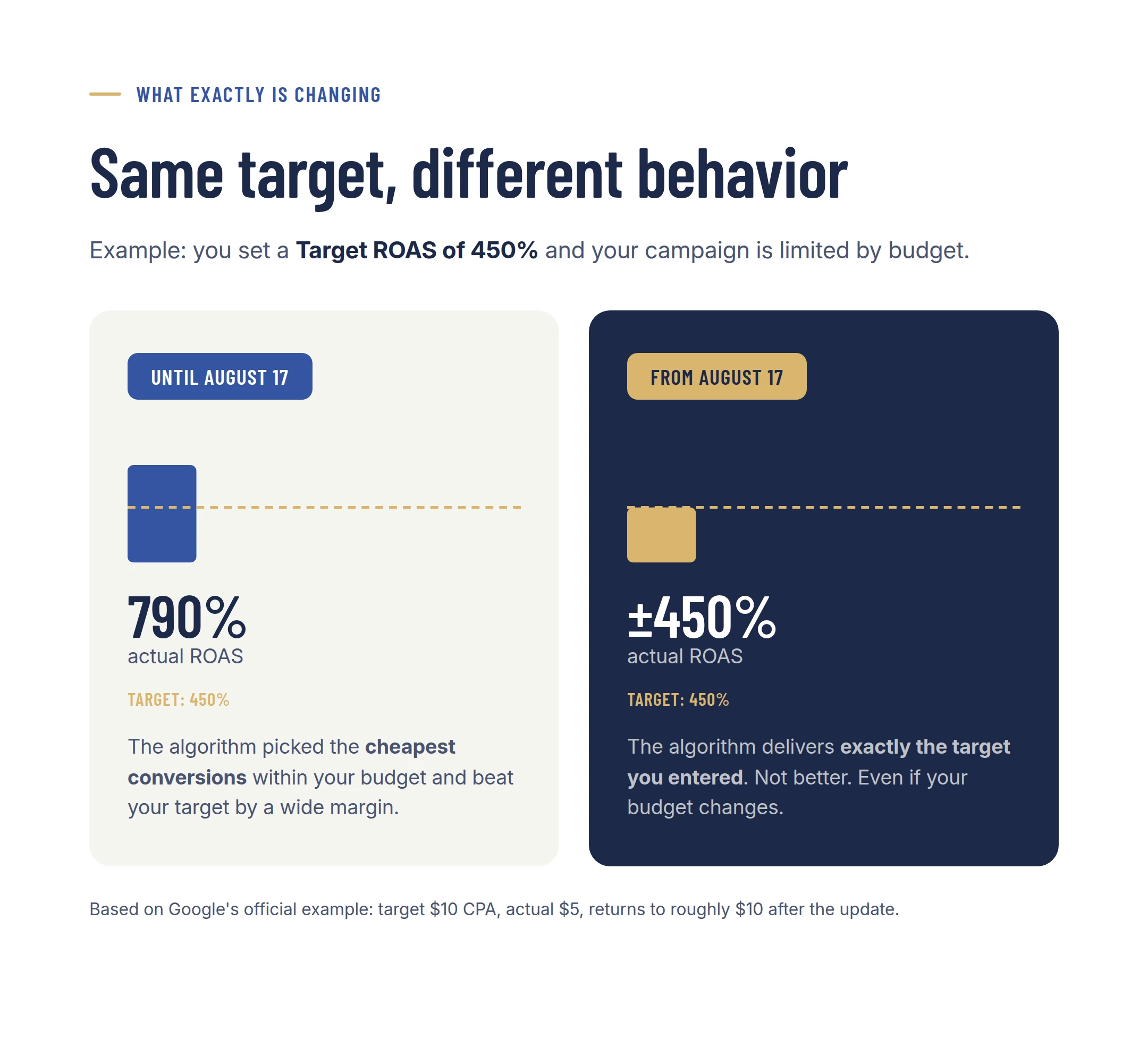
As of August 17, that is over. The algorithm now optimizes consistently toward exactly the target you entered, whether your budget is limited or not. 450% is 450%. Not better. For multi-channel campaigns like Performance Max and Demand Gen there is an added benefit: if you raise budgets, the distribution across channels becomes more predictable.
Important to know: Google does not adjust anything itself. No target, no budget. The change lies purely in how the algorithm interprets your existing settings. Doing nothing is therefore also a choice. Possibly an expensive one, because without intervention your actual efficiency slowly drifts back to the target you once entered.
Who this affects
The update only affects campaigns that meet two conditions at the same time:
- The status "Limited by budget"
- A target-based bid strategy: Target CPA, Target ROAS or Target CPC (Demand Gen)
The change applies to Search, Shopping, Performance Max, Demand Gen and Travel. App campaigns and Video Reach and Video View fall outside it. Display and Hotel already worked according to this logic.
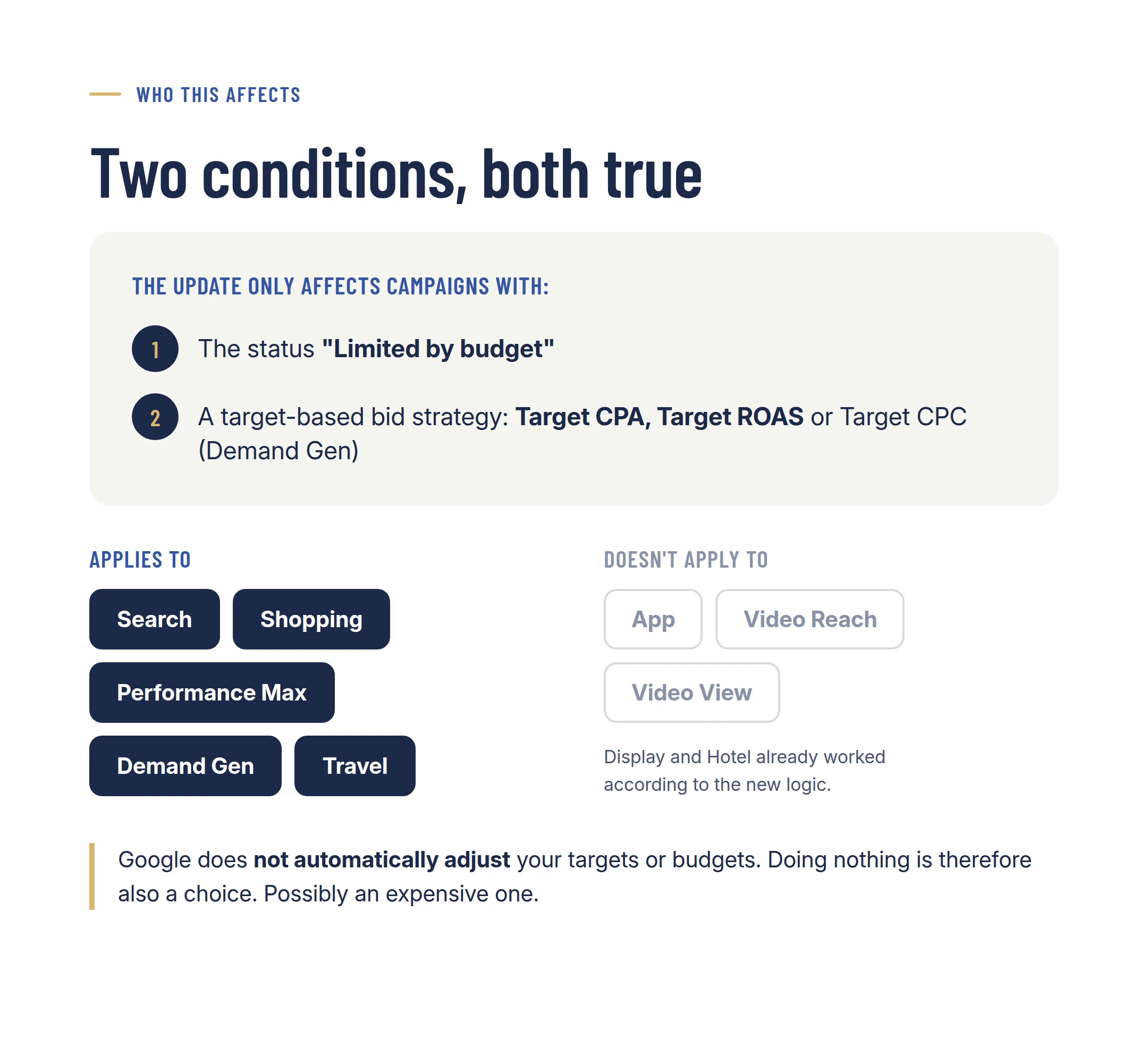
Do you run campaigns without a budget limit, or bid on Maximize conversions or Maximize conversion value without a target? Then nothing changes for you.
Is this a money grab?
The sharpest criticism in the community comes down to this: Google is taking away your overperformance and pushing you toward higher budgets. I understand that frustration, especially for accounts that deliberately ran wide targets to give the algorithm room to explore. For that strategy, the old situation was not a bug but a feature.
Still, I read it differently.
The old configuration was never really coherent. You set a target, but the moment your budget was limited, that budget became the actual steering signal and your target a non-binding suggestion. The same goal meant something different at 50 euros a day than at 500 euros a day. After the update, your target becomes the instruction and your budget a ceiling. That is conceptually cleaner.
There is also a harder economic reading that I share: that overperformance was never really yours. If you asked for 450% and got 790%, that was not an entitlement but a byproduct. The profitable auctions you now leave on the table go to advertisers who bid on them explicitly.
The real shift is therefore not financial but operational. A setting you could safely ignore for years is suddenly load-bearing. Every target in your account has to be correct from today onward. That is work. And that is precisely where the gap opens up between accounts that are actively managed and accounts on autopilot. This update widens that gap.
Why this is especially sharp for webshops
For e-commerce there is a catch that most advice leaves out: the Target ROAS version of this story is more painful than the Target CPA version.
With Target CPA you trade efficiency for volume. Your CPA rises toward your target, but within the same budget you get more conversions in return. With Target ROAS on a fixed budget, a ROAS that drops back from 790% to 450% simply means less revenue from the same amount. There is no volume gain to offset it.
And be careful with the standard advice to "raise your budget". More reported conversions are not automatically incremental revenue. Part of what the platform counts as extra conversions, you would have gotten organically or through other channels anyway. So do not calculate with platform ROAS, calculate with your margin: what is your break-even ROAS per category, and does your new effective ROAS still sit above it? That is the sum that matters.
Three routes, you choose
Check your campaigns with the status "Limited by budget" this week and make a deliberate choice for each one:
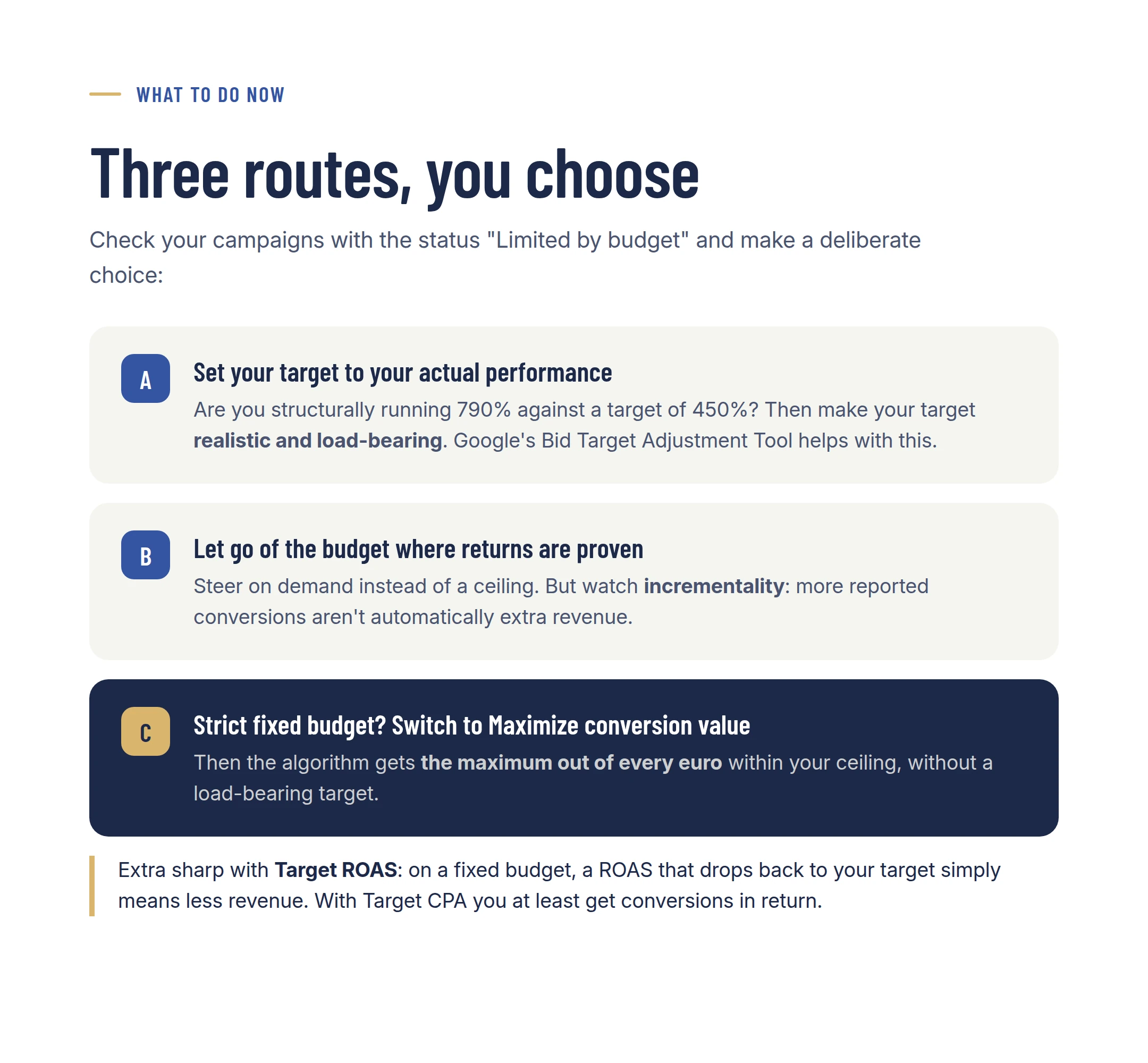
Route A: set your target to your actual performance. Are you structurally running 790% against a target of 450%? Then make your target realistic and load-bearing. Since early July, Google offers a Bid Target Adjustment Tool with which you can review affected campaigns and adjust targets based on historical performance.
Route B: let go of the budget where returns are proven. Steer on demand instead of a ceiling. But do it with your margin glasses on: calculate on incremental revenue, not on platform conversions.
Route C: strict fixed budget? Switch to Maximize conversion value. Then the algorithm gets the maximum out of every euro within your ceiling, without a load-bearing target that suddenly means something different than last month.
What this says about where Google is heading
This update fits a broader movement: Google is making its systems more consistent and placing responsibility for the settings more clearly with the advertiser. The algorithm executes what you fill in. Exactly that, no more and no less.
That aligns with how I look at AI in marketing myself: the system proposes and executes, but the human sets the boundaries. Targets you left on autopilot were always a risk. Now they are a direct cost.
Want to know what this update concretely means for your Google Ads account? I am happy to take a look with you. Schedule an intro call or send a message via LinkedIn.
E-commerce
Ready to put this into practice?
Discover how Format FWD can help your organisation with strategy, AI and leadership.
Related articles

Download the playbook: Black Friday starts on November 1
Most webshops start their Black Friday campaign on November 23. By then, I've been at it for three weeks. Download my free playbook: 10 steps, from early access to countdown.

What four years running an international webshop taught me about healthy growth
Revenue grows easily, margin does not. Four years of end responsibility for an international webshop taught me where the real difference is made. Three lessons every webshop owner can use.